
Our first questions were:
- How to best reach our customers and get them to agree to interviews?
- How might we minimize the effort and maximize the benefit, given that we are all busy in our day-to-day business?
1. Defining a process & evaluating training options
Recognizing that many of us had limited experience with user research, we started by defining a framework to guide everyone through the process. This included a template for creating a research plan, guidance on which method was appropriate for answering each research question, templates for an interview script or usability test, and a guide for analyzing qualitative data. This approach has the added benefit of saving time on preparation work and ensuring consistency of operation.
To achieve this, we looked at best practices in both, qualitative research and UX research in particular. There are many books and online resources on this, and we chose what we thought would work for us. For the start, we can recommend having a look at the following resources: maze.co and Nielsen Norman Group and the book “Continuous Discovery Habits” by Teresa Torres.
In addition, we selected several online trainings and courses on Udemy to expand the knowledge of our PO and Design team on conducting user interviews and how to ask questions correctly, which is a crucial part for gaining valuable insights.
Here is the first piece of advice: For your colleagues to feel comfortable conducting user research, you need to train them, especially on how to ask questions without influencing the customer and how to get them to open up. It helps to establish this process together by asking them what they need in the first place.
2. Defining a recruiting strategy
Second, we started defining a customer recruiting strategy. We decided to target our customers where they meet us every day, right in the app. To do this, we developed our own recruiting feature that we can activate when we need to. Once a user has completed an action, they receive an invitation to an interview and we offer an incentive in the form of a €30 Amazon voucher.
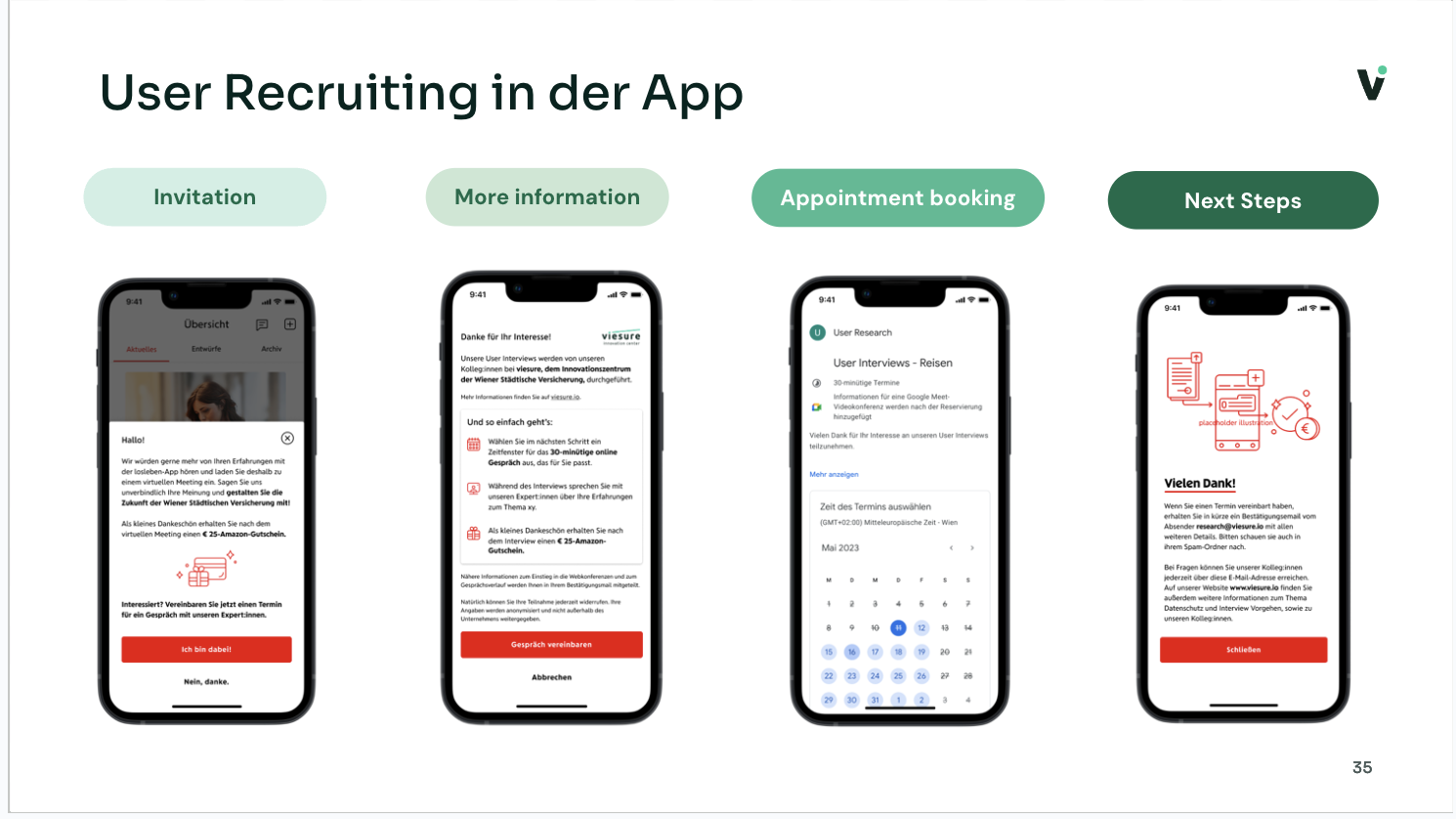
To make the time finding process as smooth as possible, we used the Google Calendar Appointment Schedule feature where customers can simply pick from a list of available time slots. The option of choosing a date was greatly appreciated by our customers, when asking how they found the process.
Here is the second piece of advice: Having a systematic and automatic recruiting process in place will make a huge difference in how much testing you conduct. Plus, the quality of your recruiting will immediately increase the quality of your test results. It’s best to design the recruiting process as simple as possible or automated as far as possible.
Building a repository of test participants
At the end of each interview, we ask our customers if they would like to participate more often. Once they agree, they are added to our research repository. This allows us to gather feedback quickly when needed, as we can skip the intro round and the standard intro questions. The repository can also include non-clients that we find in our personal network. Just be sure to match your audience to your research questions.
3. Evaluating different tools
When we thought about the other main drivers of effort, we quickly came up with the transcription of recorded interview sessions and the whole analysis part. This has led to an evaluation of various tools that can support us with automatic transcription and analyzing data. Other criteria were pricing, usability and UI design and of course data security. In the end, we chose to go with Condens.

Firstly, it has an automatic transcription feature that saves us a lot of time. Secondly, it is a dedicated tool for UX research helping us to analyze different methods such as interviews, surveys or usability tests, and to organize our data in an easy and convenient way. It provides a stakeholder repository for sharing findings across the company as well as a test participant repository. We were also convinced by the design, ease of use, the flexible pricing model and the support they offer.
Here is the third piece of advice: When evaluating tools, start by identifying what is important for you, prioritize these findings, rank everything they offer and decide together which is best for you and your colleagues. They need to feel comfortable working with it.
Summary & Outlook
The steps described above have helped us define how to reach and recruit our research participants. We evaluated and decided on where we’re going to develop our research repository and have prepared the team for our first research activities. In the upcoming articles, you can expect to read about our first interviewing campaign and we will share some valuable tips and lessons learned.
Thank you for reading, and see you next time!
P.S.: If you would like to help us develop new products and services by participating in a research activity, check out our User Research page.